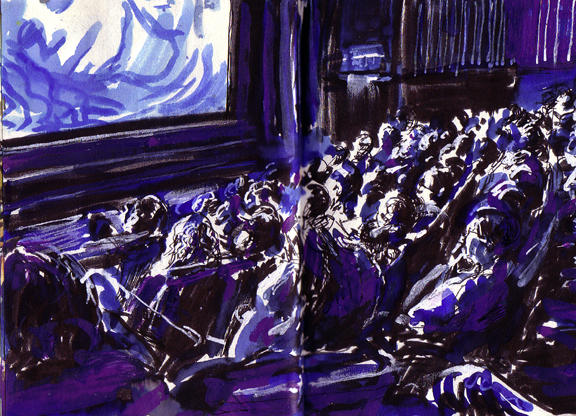
I went to a
Chroma reading last night at Waterstones on Oxford Street (
Chroma is a literary journal in which my poems have appeared) to watch my writer-pal Brynn read his winning story,
Spawn of the Regime. While he was chatting to Louise Hercules, this month's
Chroma cover-girl, I sat down with a mince-pie and a glass of water and looked around at the crowd. Straight away, I found my eyes drawn to a familiar face on the other side of the room. It was a face I will never forget, probably because it's so closely associated with a time in my life in which I was happiest. "Caroline," I said, raising my voice above the crowd. "I knew it was you!" she said.
The most interesting thing about my friendship with Caroline (a friend of mine at primary school) was more the backdrop over which our friendship played out - the fact that the school we attended was such a special place - the stuff of dreams, really, or of Harry Potter as Caroline said last night. In the heart of the English countryside,
Tockington Manor was surrounded by acres of grounds in which we could lose ourselves for hours: sometimes we'd read together quietly in the woods; sometimes we'd venture far into the trees and sit on a moss-covered rock that we called, oddly, 'the quarry'; sometimes we'd tell stories and fantasize we had magic powers; at all times, though, we were surrounded by nature, by rabbits running through the vast fields, by enormous oak-trees that swept their leaves across the green, and deep woods that rustled their leaves, and pear trees that grew against the old stone walls. It was as if the headmaster and his wife believed in the Romantic ideal that contact with nature is crucial to the instruction of sensitive beings - and I am grateful to my mother and the Toveys for allowing my soul to be attuned, at least for a time, to the natural rhythm of the universe. The experience was character-building and continues to influence my creativity today.
When I think about it now, and realise how far the lives of Caroline and myself have diverged, and how good that time was and how it's now gone, and the years of alcoholism that followed, I feel sad; until I think that other children are enjoying today what I enjoyed all that time ago. This is an extract from a poem by Samuel Taylor Coleridge, in which he writes about what I'm trying to say more lucidly than I ever could. It's called 'Frost At Midnight' and it's addressed to his son, Hartley:
Dear Babe, that sleepest cradled by my side,
Whose gentle breathings, heard in this deep calm,
Fill up the interspersed vacancies
And momentary pauses of the thought!
My babe so beautiful! it thrills my heart
With tender gladness, thus to look at thee,
And think that thou shall learn far other lore,
And in far other scenes! For I was reared
In the great city, pent 'mid cloisters dim,
And saw nought lovely but the sky and stars.
But thou, my babe! shalt wander like a breeze
By lakes and sandy shores, beneath the crags
Of ancient mountain, and beneath the clouds,
Which image in their bulk both lakes and shores
And mountain crags: so shalt thou see and hear
The lovely shapes and sounds intelligible
Of that eternal language, which thy God
Utters, who from eternity doth teach
Himself in all, and all things in himself.
Great universal Teacher! he shall mould
Thy spirit, and by giving make it ask.
Therefore all seasons shall be sweet to thee,
Whether the summer clothe the general earth
With greenness, or the redbreast sit and sing
Betwixt the tufts of snow on the bare branch
Of mossy apple-tree, while the nigh thatch
Smokes in the sun-thaw; whether the eave-drops fall
Heard only in the trances of the blast,
Or if the secret ministry of frost
Shall hang them up in silent icicles,
Quietly shining to the quiet Moon.
 With its opulent lining and elegantly tapered waist, this unusual suit - fresh from the garment house A Suit That Fits - has a definite touch of the baroque. Brilliantly fitted with a gorgeous lining, it clings like a lover to the sides of your chest, heightening every sensation. One touch of the pure wool fabric, liberally padded and lined with satin, and we guarantee you’ll never want to wear anything else. Sit in it for a while, as I am doing now, and you begin to notice all kinds of things. First there is the ticket pocket, a small flapped opening halfway down the torso on the left hand side, perfect for storing theatre tickets and other random things; then there is the fine slate pinstripe, quiet enough to make an impression without dominating the overall look. A suit, we think, that’ll add a whole new dimension to your wardrobe – the exotic look of the 21st century ‘corporate baroque'.